
Why Has Shaolin Kung Fu Been Passed Down for a Thousand Years and Taken the World by Storm?

Spanning a thousand years of history,
it has emerged from an ancient temple deep in the mountains to the world stage,
becoming a spiritual totem in the hearts of countless practitioners.
Its legend is no accident.
It stems from a unique cultural heritage,
a skill system forged through real combat,
and the inclusive wisdom of compassion for all living beings.
What Is Shaolin Kung Fu?
Shaolin Kung Fu is a traditional cultural system historically formed within the specific Buddhist cultural environment of the Shaolin Temple on Songshan Mountain. Rooted in the belief in Buddhist divine power, it fully embodies the wisdom of Chan Buddhism, with martial arts practiced by Shaolin monks as its primary form of expression.
Its most prominent feature is the unity of Chan and martial arts—integrating Chan into martial practice and cultivating Chan through martial training, hence also known as Martial Chan. Shaolin Kung Fu boasts a complete technical and theoretical system, taking martial techniques and forms as its outward expression, and Buddhist faith and Chan wisdom as its cultural essence.
01 A Thousand Years of Historical Inheritance
The Shaolin Temple is the cultural cradle of Shaolin Kung Fu. As the temple evolved through history, Shaolin Kung Fu continuously developed and refined itself. Originating as a means to dispel fatigue, ward off wild animals, maintain health, and protect temple property, it grew into a cultural form emphasizing the unity of internal and external cultivation through Chan and martial arts.
Founded in the 19th year of the Taihe reign of the Northern Wei Dynasty (495 AD), the Shaolin Temple was an imperial Buddhist sanctuary built by Emperor Xiaowen of the Northern Wei to honor the Indian monk Batuo.
In 527 AD, the arrival of Bodhidharma, the 28th Patriarch of Buddhism from the West, infused Chan wisdom into Shaolin. He meditated facing a wall in a cave behind the temple for nine years, founding Chan Buddhism, which then took root and spread at the Shaolin Temple.
During the late Sui Dynasty, the story of Thirteen Shaolin Stick Monks Saving Prince Qin made Shaolin Kung Fu famous throughout China. It gradually matured and spread widely during the Song, Jin, and Yuan dynasties.
The Ming Dynasty marked the golden age of Shaolin Kung Fu. Yu Dayou, a famous general who fought against Japanese pirates, visited the temple and taught practical stick techniques.
In the Qing Dynasty, the Shaolin Temple declined due to political suppression. Shaolin martial arts gradually spread to the folk and evolved into various schools.
After the founding of the People’s Republic of China, the value of Shaolin martial arts was continuously explored. In 2006, Shaolin Kung Fu was inscribed on the National List of Representative Intangible Cultural Heritage Items, becoming an important medium for international exchanges of traditional Chinese culture.
02 An Exquisite Technical System
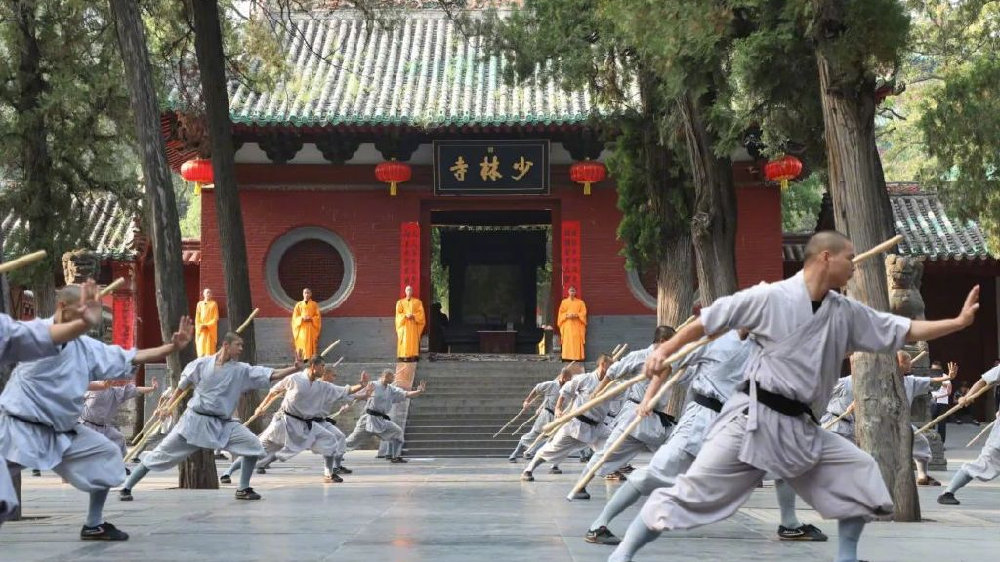
When people speak of Shaolin Kung Fu, stick-wielding monks often come to mind first. The staff indeed holds a pivotal position in Shaolin Kung Fu and reflects Buddhist culture. Made from wood, the staff has deterrent power but limited lethality compared to cold weapons. For the Shaolin Temple, martial arts were originally intended for self-defense rather than harming others—using the staff as a weapon embodies the Buddhist concept of compassion.
Shaolin warrior monks’ weaponry extends far beyond the staff. Along with the basic wooden staff, their daily training includes boxing, spears, willow-leaf swords, and other advanced weapons.
In the Hall of Western Sages at today’s Shaolin Temple, 48 footprints of varying depths are clearly visible. Though seemingly disorderly, they follow strict rules and form a complete set of Shaolin boxing when connected.
Shaolin Kung Fu is a broad concept encompassing numerous categories—a vast technical system, not merely a “school” or “style” in the ordinary sense.
According to ancient boxing manuals preserved at the temple, Shaolin Kung Fu includes 708 forms: 552 boxing and weapon forms, plus 156 training methods such as the Seventy-Two Unique Skills, grappling, combat, bone-setting, acupressure, and qigong. Surviving and recovered forms total 545: 178 boxing forms, 193 weapon forms, 59 paired practice forms, and 115 other methods.
These contents are organically integrated into a large, orderly technical system by category and difficulty level.
03 A Cultural Symbol of China
“All martial arts under heaven originate from Shaolin; Shaolin Kung Fu reigns supreme under heaven.”
As an iconic symbol of Chinese martial arts, Shaolin Kung Fu has long gone global and taken the “world martial arts community” by storm.
The Shaolin Temple has always valued the inheritance and spread of martial arts. Historically, Shaolin monks marched down the mountain many times to assist imperial armies or local authorities in quelling unrest, spreading Shaolin Kung Fu to the general public.
The temple also welcomed chivalrous warriors and martial artists from all over to study and exchange, promoting the integration of martial arts. In modern and contemporary times, amid China’s reform and opening-up and the revival of traditional culture, numerous films, TV shows, and cultural events centered on Shaolin Kung Fu have been widely held, allowing it to take root and thrive overseas.
Shaolin Kung Fu’s worldwide popularity as a global calling card owes much to the aspiration of Grand Master Abbot Yongxin. By the late 20th century, he had actively promoted Shaolin Kung Fu to go global, enabling martial arts enthusiasts worldwide to practice and benefit from it.
Beginning in 1990, the Shaolin Temple Warrior Monks Group traveled beyond the temple, forging connections across China and the world. Countless enthusiasts at home and abroad flocked to the Shaolin Temple to study and train.
After China joined the WTO in 2002, the world embraced diversified development, with different cultures flourishing together. Guided by the Buddhist spirit of compassion, loving-kindness, joy, and equanimity, the Shaolin Temple has continuously sent outstanding masters and warrior monks worldwide to spread Shaolin culture and promote its unique healthy, green lifestyle for the physical and mental well-being of all humanity.
Today, the Shaolin Temple operates more than 200 overseas cultural centers in over 100 countries and regions, and has established the Shaolin Federation across five continents to spread Shaolin culture.
In 2019, to further popularize Shaolin Kung Fu, Abbot Yongxin organized veteran martial arts masters to develop the Shaolin Kung Fu Duanpin System, offering suitable practices for teenagers, adults, and the elderly. This standardized system has boosted the global promotion and social popularization of China’s intangible cultural heritage, fostering understanding and friendship between different cultures.
In late 2021, Abbot Yongxin initiated and successfully held the world’s first online Global Shaolin Kung Fu Assessment Competition. In the summer of 2024, over 20,000 practitioners from six continents participated in the preliminary rounds; 124 finalists, named “Intercontinental Shaolin Kung Fu Stars,” gathered at the Shaolin Temple on Songshan Mountain for the global finals, sharing a grand feast of international cultural exchange.
Whether practitioners of different nationalities, skin colors, and ages practice together in front of the temple gate, or Shaolin Kung Fu is brilliantly showcased at international cultural events, it vividly demonstrates Shaolin culture’s vital role in integrating diverse cultures and enhancing mutual understanding and friendship among people worldwide, contributing unique Shaolin strength to building shared human values.
—
Today, Shaolin culture stands open and inclusive as a bridge for cross-civilizational communication, and Shaolin Kung Fu increasingly serves as a cultural bond transcending nations and languages.
Shaolin Kung Fu
Through a thousand years of trials and tribulations,
it continues to shine brightly.
It is not only a precious cultural heritage of the Chinese nation
but also a treasure of human civilization.
In the river of history,
Shaolin Kung Fu will keep serving the physical and mental health of all humanity,
carrying on its legacy forever.
